A Unique House Sit in Spain: Ribadiso Albergue on the Camino de Santiago

There’s hardly a more tranquil place on Earth. And I was lucky enough to be there, in a sort-of house-sitting capacity, in May.
Surrounded by rolling hills and farmland, just 40 km from the holy city of Santiago de Compostela on the Camino de Santiago in Spain, stands a renovated stone albergue (hostel) that has served pilgrims since 1523.

Pilgrims walk through cool woodlands and across a medieval bridge to get there.

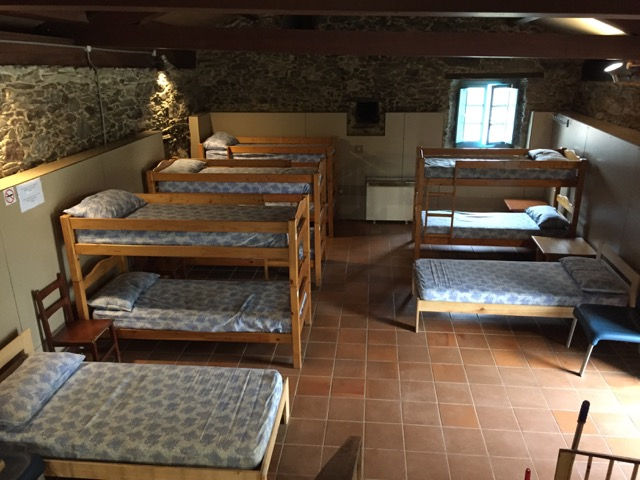
They enter through heavy blue doors and register. It costs a certified pilgrim just six euros to get a bed for the night here.
Then pilgrims discover that about five yards from this building is a congenial bar-restaurant that serves coffee, beer, drinks, and traditional Spanish foods (including a three-course pilgrim meal and wine for 10 euros) from 6:30am until 9:30pm. They are relieved that they don’t have to go far for food.
And the bonus? For no extra charge, on a hot day they can dangle their tired, blistered feet in the cold Rio Iso that runs alongside the albergue.
This was the piece of paradise where I volunteered for two weeks in May under the auspices of the American Pilgrims on the Camino organization.
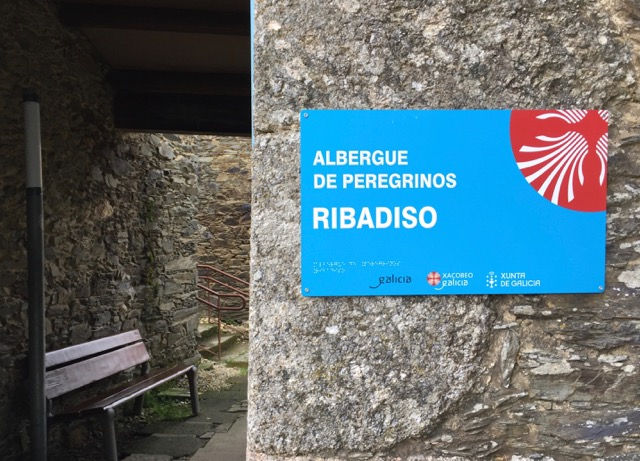
It’s called the Albergue de Peregrinos—Ribadiso. It is run by the Xunta de Galicia, the government of the province of Galicia, and staffed by the Xunta (pronounced “shunta”).
To explain a bit: Galicia is the westernmost province of Spain, touching the Atlantic. It’s capital is Santiago de Compostela, the ancient city which has been, for 1200 years, the destination of the famous Camino pilgrimage (known in English as The Way of St. James). The city is home to the world-class cathedral that reputedly houses the bones of the Apostle James.
My job there in paradise? Along with another American volunteer, Denise, at 8:00 am, I went into the “habitacions.” (Pilgrims are expected to leave by 8:00.) We swept the floors and removed any disposable sheets and pillowcases that hadn’t been deposited in the trash by pilgrims. Later in the morning, the paid staff came in and mopped the floors.
After that, we’d breakfast in our little apartment and have a few unassigned hours.
Because the only reliable wifi in the village was available at the bar-restaurant, often we’d go there for café con leche and to check emails and headlines.
When the albergue opened at 1pm, the fun began. Our job was to welcome the pilgrims, show them to their beds and the washing area, and then be available if any of them wanted to share their experiences. My goodness, what ones learns!
Truly, the United Nations walks the Camino. In the two weeks we were there, we had pilgrims from 38 countries: Argentina, Austria, Australia, Belgium, Brazil, Bulgaria, Canada, Chile, China (Taiwan), Colombia, Czech Republic, Denmark, France, Germany, Hungary, Ireland, Italy, Japan, Korea, Lithuania, Moldova, Morocco, Netherlands, New Zealand, Norway, Poland, Portugal, Romania, Slovenia, South Africa, Spain, Sweden, Switzerland, Turkey, Ukraine, Uruguay, UK, and USA.

We discovered every pilgrim is unique. Many walk alone. Others come in friendship or family groups—for example, a German father/Spanish mother/ and two children, age 5 and 8, arrived one night. A few pilgrims spoke no Spanish or English—like several brave Koreans, an elderly Japanese woman who bowed repeatedly, and two Polish women who knew only their language. But many pilgrims, especially those from northern Europe, are facile “American English” speakers, which made it very easy for me to communicate.
The oldest pilgrim I met there was 86, walking his eighth Camino. Another man said he’s walked 17 times. Once a lovely couple came on a tandem bike–the wife is blind.

Some people arrived exhausted, walking in pain. Others are fit and energetic, and a few do 40 km (30 miles) a day. One man walked mostly barefoot, but used thin-soled leather shoes on tarmac, which is hard on feet. Another woman used thin toe-shoes the whole way (about 500 miles) and never got a blister.

Most of our pilgrims carried their belongings in large backpacks. A few had their packs transported by a courier service. Some arrived by bicycle. A very few passed over our bridge on horseback, but our albergue couldn’t accommodate them.

I found my two weeks in Ribadiso restorative, inspiring, and reassuring. The real world, I was reminded, is filled with kind, creative, and resourceful people who get along with strangers.
Occasionally people ask me what my most unusual house sit has been in the seven years I’ve been nomadic. Although one might debate whether this Ribadiso experience was a house sit, I’m declaring that it qualifies. For while there, for 24-hours-a-day I participated in caring for a home that housed hundreds of people. It was an expansive experience in a beautiful place. It was win-win. I’d readily do it again.
That ticks enough of the house-sitting boxes (as the Brits say) for me. So I’m voting it as my most unusual experience.
¡Ultreia y suseia! (A Camino pilgrim’s phrase that translates roughly as “onward and upward.”)


Comments